The final phase focuses on long-term sustainability.
By this stage, the aim is to move away from “protocol mode” and toward informed flexibility while keeping the core habits that helped your system stabilise.
Earlier phases of the Multi-Symptom Reset focused on calming the digestive system, reducing irritation, and gradually rebuilding microbiome balance. Phase 4 shifts the focus toward living normally again — but with awareness and resilience.
This phase is not about returning to old patterns overnight.
It is about testing tolerance, expanding variety, and building a realistic long-term rhythm.
The ultimate goal of the Multi-Symptom Reset is not lifelong restriction.
It is clarity, stability, and autonomy.
Goals for This Phase
• Reintroduce previously avoided foods in a structured and mindful way
• Identify true intolerances versus temporary sensitivities
• Expand dietary variety wherever possible
• Build confidence and reduce fear around food
• Establish a sustainable long-term lifestyle using the 80/20 principle
Progress during this phase often looks like:
• increased food tolerance
• fewer symptom flare-ups
• less anxiety around meals
• improved energy stability
• greater flexibility in social situations
Why Reintroduction Matters
Remaining in highly restrictive diets indefinitely can reduce microbiome diversity and increase anxiety around food.
Many sensitivities that appear during periods of gut irritation are temporary, not permanent.
Once inflammation has reduced and the digestive system has stabilised, the body can often tolerate a wider range of foods again.
The purpose of this phase is to discover your true tolerance window rather than assume restriction must continue forever.
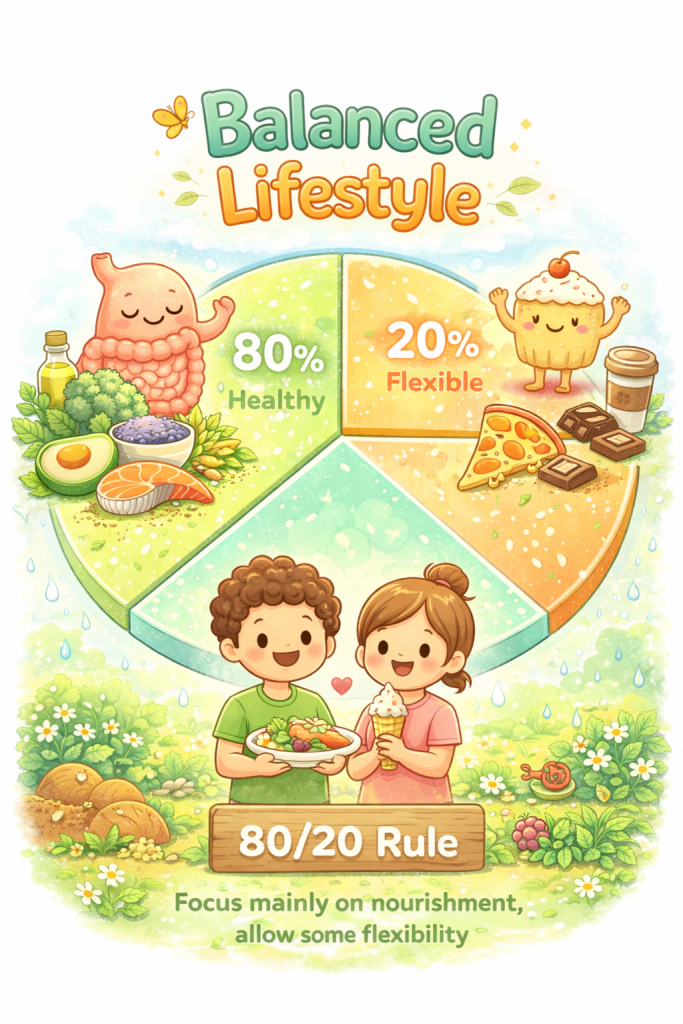
The 80/20 Lifestyle Approach
The long-term framework used in this phase is the 80/20 rule.
This means that approximately:
80% of the time
you prioritise the supportive habits and foods that helped stabilise your system.
20% of the time
you allow flexibility without guilt or fear.
This balance prevents the cycle of:
• perfection → restriction → burnout → relapse
Instead, it supports a realistic and sustainable lifestyle.
The 80/20 principle only works well after stability has been achieved. If symptoms are still highly reactive, returning temporarily to earlier phases may be helpful.
Structured Food Reintroduction
Foods that were avoided in earlier phases should be reintroduced slowly and intentionally.
Adding too many foods at once makes it difficult to identify what is actually causing symptoms.
A simple reintroduction method
- Choose one new food to test.
- Introduce a small portion first.
- Keep the rest of your meals simple and unchanged for 24–48 hours.
- Observe how your body responds.
- If symptoms remain stable, gradually increase the portion over several days.
If symptoms return, pause the food temporarily and revisit it later once stability returns.
Foods Commonly Reintroduced in This Phase
Every individual will have a different tolerance pattern, but foods often reintroduced in this phase include:
• tomatoes
• bell peppers
• fermented foods
• coffee or stronger teas
• higher-sugar fruits
• small amounts of dairy (if desired)
• occasional processed foods
These foods are not inherently harmful — the goal is to understand how your body responds to them.
Recognising True Intolerance vs Temporary Sensitivity
One of the most important lessons during this phase is learning the difference between foods that truly do not work for your body and foods that were only problematic during periods of inflammation.
A useful question to ask is:
“Does this food consistently trigger symptoms when my system is otherwise stable?”
If the answer is yes, it may be a genuine intolerance.
If symptoms only appear during stressful periods, poor sleep, or dietary overload, the food itself may not be the primary issue.
This perspective helps prevent unnecessary long-term restriction.
What To Do If Symptoms Flare
Occasional flare-ups are normal during reintroduction phases.
A flare does not mean the entire process has failed. It usually means the system needs a brief return to stability.
If symptoms increase:
• simplify meals for a few days
• return temporarily to your most stable foods
• avoid introducing new variables
• prioritise sleep and hydration
• reintroduce foods more slowly
Earlier phases of the protocol remain useful tools that can be revisited whenever needed.
Maintaining Core Habits
Even though this phase allows flexibility, many people find it helpful to maintain a few core habits that supported their healing journey.
Examples include:
• prioritising whole foods most of the time
• maintaining a steady meal rhythm
• avoiding excessive ultra-processed foods
• supporting sleep and nervous system regulation
• paying attention to stress levels and recovery
• use celtic sea salt daily
These habits create a stable foundation while still allowing flexibility.
Tea Guidance – Phase 4
Tea choices become more flexible in the final phase.
Many individuals continue enjoying the teas introduced earlier in the protocol while gradually expanding their choices based on personal tolerance.
Common long-term tea habits include:
• white tea or green tea earlier in the day
• chamomile tea in the evening for relaxation
• limiting very strong caffeine intake if reflux or anxiety is easily triggered
The goal in this phase is not strict rules, but awareness of what supports your body best.
Daily Support Practices –
Continue to do the Daily ’10-minute reset’, allowing some days off within the 80/20 guide.
Supporting the Body’s Natural Detox Pathways
Alongside food and supplements, gentle daily practices can help support circulation, breathing patterns, lymphatic flow and nervous system balance.
These practices are intentionally simple and take only a few minutes. The goal is not intensity, but consistency and gentle stimulation of the body’s natural systems.
Morning Breathing Exercise
The lungs play an important role in removing metabolic waste and supporting oxygen delivery throughout the body.
A few minutes of slow, intentional breathing each morning can help support circulation, nervous system balance and oxygenation.
Simple breathing routine
• Sit or stand comfortably
• Inhale slowly through the nose for 4 seconds
• Hold gently for 2 seconds
• Exhale slowly through the mouth for 6 seconds
• Repeat for 3–5 minutes
This can also help activate the parasympathetic nervous system, which supports digestion and recovery.
Posture Reset Exercise
Poor posture can place pressure on the abdomen and diaphragm, potentially aggravating reflux and digestive discomfort. It can also affect breathing patterns and neural communication through the spine.
A simple posture reset can help open the chest, improve breathing mechanics and reduce unnecessary tension.
Basic posture reset
• Stand upright with feet shoulder-width apart
• Roll shoulders gently backwards several times
• Lift the chest slightly without arching the lower back
• Lengthen the back of the neck
• Take several slow breaths in this position
Practising this for 1–2 minutes in the morning can help set a healthier posture for the day.
Lymphatic Activation (Daily)
The lymphatic system helps move waste products and immune cells throughout the body. Unlike the circulatory system, it relies heavily on movement and muscle activity to circulate fluid.
A simple daily lymphatic activation routine can support this natural flow.
Gentle lymphatic activation routine
• Lightly shake or bounce the body for 30–60 seconds
• Use gentle rubbing or sweeping motions toward the lymph nodes:
Move hands toward:
• the armpits
• the groin area
• the collarbone region
The movements should be light and rhythmic, not forceful.
This routine typically takes 2–3 minutes and can be done in the morning or before a shower.
Dry Brushing
Once Phase 3 begins and the body is more stable, dry brushing can be introduced as an additional lymphatic support practice.
Suggested frequency:
• every other week
• before showering
Use a natural bristle lymphatic brush and brush gently toward the heart.
Typical brushing directions:
• feet → toward knees
• hands → toward shoulders
• torso → toward lymph nodes (armpits and groin)
Avoid brushing irritated or inflamed skin.
Why These Practices Are Included
These practices are included in the protocol because they help support:
• circulation
• lymphatic movement
• breathing patterns
• nervous system balance
• detoxification pathways
They are intentionally simple so they can be sustainable long term.
Consistency is more beneficial than intensity.
A Note on Pace
If energy levels are low, these practices can be shortened or performed more gently.
Even 1–2 minutes per day can still support the body without creating additional stress.
The aim is to support the body’s natural systems — not overwhelm them.
The Long-Term Goal
By the end of this phase, the intention is that the protocol itself becomes unnecessary.
Instead of following rigid rules, you will have developed:
• awareness of your personal triggers
• confidence in your food choices
• resilience within your digestive system
• flexibility in everyday life
Health is not a fixed state.
It is a dynamic relationship between lifestyle, environment, stress, and nourishment.
This phase supports balance rather than control.
Moving Forward
The Multi-Symptom Reset was designed as a structured pathway — not a permanent restriction.
Once you reach this phase, the focus shifts toward living well rather than constantly managing symptoms.
Your body now has the tools to maintain balance.
The rest is about listening, adapting, and living fully.
 Vision of Vitaliy